Case Study · Premium Consumer Goods
+74 % revenue in 16 months. On the same budget.
There was no bigger marketing budget, no new agency and no new product. What changed was the fit: between what customers genuinely valued, what the brand said about it, and what the company was able to deliver. And the question of what the existing money was actually being spent on. Here is the order I worked in.
 Simon Förstemann
Growth Strategist
August 2026
Simon Förstemann
Growth Strategist
August 2026
Before we start, a word on who this applies to. The example comes from an established company, but the actual content here is not the tactic, it is the system behind it: the order in which decisions get made. And that logic works regardless of a company's size or age.
It works for established companies that sense their growth is stalling even though the product is good. It works for well-known brands whose message has blurred over the years because many people have worked on it. And it works for startups that do not have a single customer yet.
In that last case only the source shifts, not the principle. If you have no customers of your own, you have no reviews of your own either. So you talk to the market you want to win, and you read the reviews of the competitors those people buy from today. What gets praised and criticised there is the most precise template you will ever get. Startups have a considerable advantage here: they have nothing to unlearn. They can follow the right order from the start instead of paying dearly to fix it later.
The starting point
An established company in premium consumer goods. Award-winning design, high-quality product, decent awareness. And yet the business was no longer growing the way the product should have allowed. I was asked to take over marketing.
The obvious reflex in that situation is always the same: more campaigns, more channels, more budget. That is precisely what I did not do.
Step 1: Listen to customers before deciding anything
I started by taking stock, and then I talked to people. To every employee, and above all to customers. On top of that I did not skim customer reviews, I read them. Hundreds of them.
It sounds unspectacular and it is the most important step of the entire project. Because it produces something no analysis can deliver: a feel for why people choose this brand. Not which features they list, but what actually matters to them.
Almost every company has a notion of why customers buy. It usually dates back to the founding years, to product management or to a study. It is rarely completely wrong, but it is almost always off in one decisive place. You sell one thing, and what people love is another.
You only find that gap by genuinely listening to customers instead of surveying them. A questionnaire gives you answers to the questions you already had in your head. An open conversation gives you the thing you would never have thought of. So I did not ask for satisfaction ratings. I asked what was on people's minds in the moment they decided.
Customer reviews are the most underrated data source there is. They are free, they were written unprompted, and they are written in the customers' language rather than the language of marketing. I was looking for three things while reading:
- Which words keep coming back? Not my words, theirs. Those exact phrases later go straight into the communication, because they demonstrably hit what people feel.
- What is being praised that was never marketed? This is where the real value of the brand sits, the part it did not know about itself.
- What appears repeatedly in critical reviews? Criticism is the most precise map you can get. It shows you exactly where in the buying journey trust breaks down.
This work is uncomfortable, because it takes weeks and from the outside it looks like standstill. It is also the reason every decision after it could be made quickly: because you no longer have to debate what customers might want once you know what they say.
An underrated point: trust the existing team
Anyone stepping into new responsibility quickly feels the pressure to change something immediately. And the easiest thing to change is people. I consider that one of the most expensive mistakes there is.
The team that is already there knows the company, the products and the customers better than any outsider ever could. Very often it already knows where things are stuck. It was simply never asked, or it was asked and then nothing happened.
So I did not treat the team's concerns as background noise but as a data source. Something a person has been raising for three years is not grumbling, it is usually a precisely located problem. Several of the most effective changes in this project did not come from me, they came from the team. All I did was finally give them priority and decision-making power.
That has two effects. Professionally: you find the right levers faster. Personally: a team that sees it is being listened to carries the change instead of waiting it out. A turnaround against the team fails. A turnaround with the team keeps running, even once the hands-on partner has left.
Step 2: Look at the customer's path, not at the channels
On that basis I looked at the structure. In two directions.
Outward: how does a customer travel from first encountering the brand across every single touchpoint to the purchase? Where does trust build, where does it break?
Inward: how is the company organised? Who decides what, how does information flow, where do things get stuck?
Together, those two perspectives give you the real picture. A touchpoint is rarely bad because someone is doing bad work. It is bad because nobody inside owns it.
The diagnosis
There was a gap between what customers actually valued the brand for and what the brand communicated at its touchpoints. Not wrong, but out of focus. And at several points in the buying journey simply absent.
Step 3: Retell the brand without changing it
Here comes the part where most projects fail: I redesigned the brand's communication without touching its character.
The essence I had taken from the customer conversations stayed exactly as it was. What I changed was how that essence gets told, and where. The knowledge about customers became a communication matrix: which need and which psychological point has to be addressed at which touchpoint so that the next step feels obvious?
That is the difference between a rebrand and what happened here. A rebrand would have destroyed what customers loved. The point was not to build a new brand, but to finally make the existing one properly visible.
And this is exactly the point where you have to immunise yourself against something: the public marketing chatter about what you “absolutely have to do today” and what “works right now”. There is hardly another field in which so many people give universal answers so loudly. You have to be on TikTok. You need more social media. AI changes everything. Newsletters are dead, newsletters are back.
It is rarely complete nonsense, it is just not aimed at you. Advice like that comes from one specific case in one specific market with one specific audience, and is then declared a rule. For your company, the exact opposite can be the right move.
The path is different for every company and every brand, because customers, buying occasion, price, competition and your own organisation are different. Saying “do more social media” as a blanket rule is therefore not a strategy, it is a guess. Whether a channel, a format or a message is right is not decided by whether it currently counts as modern, but by whether it fits what you found out about your customers and your company in the steps before.
Following the trend means copying another company's answer to a question you never asked yourself. It is expensive, and it still feels like progress because it looks busy. That is why in this approach the listening comes first and the decision second. Never the other way round.
Step 4: Rebuild the internal structures
A good message delivered by a disorganised organisation goes nowhere. So I tore up the operational structures and rebuilt them.
That sounds grand, but it consisted of unspectacular things: fixed, regular meetings with a clear purpose. Clear ownership. Marketing processes brought up to date instead of running on as they had historically grown.
Nobody sees this work from the outside. It is the reason the result held instead of being a flash in the pan.
Step 5: Fit the channels to the processes, not the other way round
Only then came the channels. I modernised the marketing department and the channels in use and cut them to fit the new processes exactly. In parallel, the brand messaging was built up consistently and permanently, so that at every point of the customer journey the right thing gets said at the right moment.
Most companies start right here. That is why their marketing costs money without selling: the channel is optimised, but it carries a message that does not land into a process that cannot deliver on it.
Step 6: Reallocate the budget instead of increasing it
This is the point where the same money turns into more revenue. The budget stayed the same in total, but from then on it went somewhere else.
Away from channels that mainly produce reach and pretty numbers. Towards the touchpoints that genuinely move a customer along the path to purchase. The question was no longer “where can we buy cheap visibility?” but “where in the customer journey does it break down, and what does it cost to get better exactly there?”.
At the same time I opened up new channels, deliberately taking some unusual routes. Channels and formats the competition simply was not using, but which fitted the brand precisely and reached people where they actually are. That is the advantage of having listened first: you know where your own customers really look, instead of guessing or following whatever the industry currently treats as standard.
The obvious move would have been to put more money into the existing channels. That would only have made the existing gap more expensive.
Step 7: Build a data foundation you actually use
Alongside all of this, something had to be created that previously existed only in parts: a reliable data foundation. Not for its own sake, but because without it you are only exchanging opinions about impact.
Without it you do not know what customers actually do on their way, where they drop off, which channel contributes to a purchase and which one merely looks busy. And above all: you cannot tell whether a change made a difference or whether the season simply turned. It is also the precondition for reallocating budget in good conscience. If you cannot measure, you cut on gut feeling, and usually in the wrong place.
Equally important is the other direction: you must not overdo it. You do not need thirty dashboards or a report nobody reads. Not everything that counts is measurable, and plenty of what is measurable does not count. Trust in a brand cannot be captured in a metric, and anyone who only optimises what is easy to measure will dismantle their own growth.
The workable middle ground is a foundation that reliably answers three questions: what are our customers doing? What works? What does not? A few numbers someone genuinely looks at beat any complete data set nobody uses.
And after that: stay with it instead of calling it done
The most dangerous moment in a project like this arrives when everything is running. The structures are in place, the message lands, the numbers point up, and that is exactly when the feeling of being finished sets in.
You are not. That is where the real work starts, and it is unspectacular: optimise continuously, sharpen things on the basis of the data, test, keep taking customer feedback seriously. Not in big relaunches, but in many small corrections.
On top of that comes brand work, which is never finished. A brand is not a project with an end date, it is something built through repetition and lost through neglect. Stop telling the same story consistently and you will not lose your position immediately, but you will lose it. And winning it back costs a multiple of what holding it would have cost.
That is exactly why it matters to me not just to advise, but to implement alongside you and stay involved. A concept nobody carries forward after the presentation is not a strategy, it is a file.
And then, once things are running reasonably cleanly, you are allowed to increase the budget. That is not a contradiction of everything above, it is the right moment for it. Before that, more money only buys more of a problem. Now it buys growth, because it is clear which touchpoint genuinely contributes to a purchase, which message lands there, and whether the organisation can serve the additional demand at all.
That is the difference between spending and scaling. Scaling means multiplying something that demonstrably works. Which is why the order is the same here too: first make it work, then do more of it.
The result
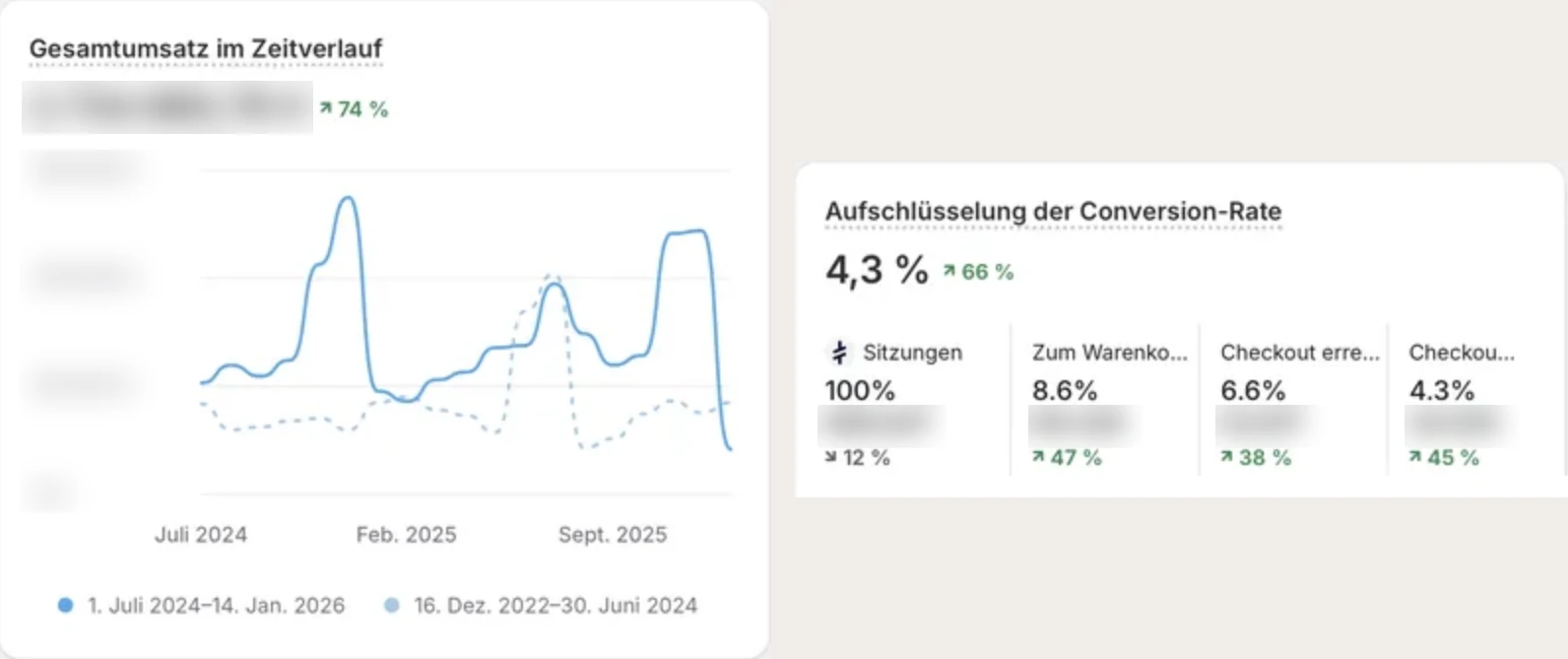
+74 % revenue in 16 months. On an unchanged marketing budget.
The most revealing part is not the revenue itself, it is what sits underneath it: the number of visitors fell by 12 % over the same period. Fewer people came, not more.
What grew was what happened to those people:
- Conversion rate: +66 % — of the people who were there, far more bought.
- Orders: +70 % — and that on less traffic.
- Added to cart: +47 %, reached checkout: +38 %, completed checkout: +45 % — the path to purchase opened up at every single stage.
- Average order value: +2 % — essentially unchanged.
That rules out the two explanations people usually reach for. It was not more reach, because reach went down. And it was not higher prices, because the order value stayed the same.
The growth came from the people who were already there finally finding what they had come for. That is the proof for the order of operations: message, processes and path to purchase first. Conversion is not a dial you turn on its own. It is the result of everything before it lining up.
No extra money, no new agency, no new product and no replaced team. What changed was the order, the message, the structures and the question of what the existing money is spent on.
What can you take from this?
The transferable core is not a tactic, it is an order of operations. Growth happens where four things line up:
- What your customers actually want. Not what you assume, and not what you sell. You only learn that by talking to them openly and reading their reviews in their language, instead of surveying them.
- What your brand tells them about it. At every touchpoint, at the right moment.
- What your company can deliver on. Processes and ownership that carry it. And a team you listen to, because it usually has the answers already.
- Where your money goes. Not into the channels with the prettiest numbers, but into the places that move customers towards a purchase.
- Whether you can see what is happening at all. A lean data foundation that answers three questions: what are our customers doing, what works, what does not.
If one of those levels is off, the budget evaporates in the others. That is exactly why more budget so often achieves so little. And exactly why none was needed here.
That does not mean more budget is never right. It means it belongs at the end, not at the beginning. Once the fit is there and you can see what works, increasing it is precisely the right lever for scaling.
What you should not take away is a list of measures. There is no path that is right for everyone, and the loudest answer is rarely yours. The order is transferable. The decisions within it are not.
And then comes the least comfortable part: it does not stop. Growth that is meant to hold needs continuous optimisation and lasting brand work. No result maintains itself.
Next step
Before you release more budget, let us find out what is actually holding you back.
Tell me where money goes in today and what comes out. I am glad to take a look and tell you where the path to purchase breaks.
After that we do the rebuild together. I stay through the execution until the numbers move.
Book a call →30 minutes · Informal introduction · Directly with Simon Förstemann
Frequently asked questions about this case study
How can you increase revenue without a bigger marketing budget?
By creating fit instead of spending more, and by reallocating the budget you already have. In this case, growth came from the brand communicating exactly what customers actually valued at every touchpoint, from internal processes being able to deliver on it, and from the budget being shifted to the channels that genuinely move customers towards a purchase. More budget does not help when message and process do not match.
What is the first step to get growth moving again?
Listening instead of campaigning. Conversations with every employee and above all with customers, plus systematically reading hundreds of customer reviews. That is where the understanding comes from of why people really choose a brand.
How do you find out why customers really buy?
Through open conversations rather than satisfaction surveys, and by systematically reading customer reviews. A survey only confirms the questions you already had in mind. Reviews were written unprompted and in the customers' own language. Look for three things: which words keep recurring, what gets praised that was never marketed, and what appears repeatedly in critical reviews.
Was the brand redesigned in the process?
No. The character of the brand was deliberately left untouched. What changed was how the existing essence is told and at which point of the customer journey. A rebrand would have destroyed precisely what customers loved about it.
Do you have to replace the team for a turnaround like this?
No, quite the opposite. The existing team knows the company, the products and the customers better than any outsider. What matters is trusting them, taking their concerns seriously and picking up the points they have been raising for years. A turnaround against the team fails. A turnaround with the team keeps running on its own.
Did the growth come from more website visitors?
No, quite the opposite. Sessions fell by 12 percent over the same period. What rose was the conversion rate, by 66 percent, and the number of orders, by 70 percent, while the average order value stayed essentially flat at plus 2 percent. So the growth came neither from more reach nor from higher prices, but from far more of the existing visitors actually buying.
Where does the budget go if it is not increased?
It gets reallocated. Away from channels that mainly generate reach, towards the touchpoints that actually move customers along their path to purchase. On top of that came new, partly unconventional channels that fitted the brand and where competitors were not present.
Does this work for startups with no customers yet?
Yes, because what transfers is not the tactic but the order in which decisions are made. It applies to established companies, to well-known brands whose message has blurred, and equally to startups before their first customer. Only the source shifts: instead of your own reviews, you talk to the market you want to win and read the reviews of the competitors those people buy from today. Startups have the advantage of having nothing to unlearn.
Do you need to do more social media to grow today?
Not as a blanket rule, because there is no blanket answer. The path is different for every company and every brand, because customers, buying occasion, price, competition and organisation are different. Advice like “do more social media” or “you have to be on TikTok” comes from one specific case in one specific market and is then declared a rule. Whether a channel is right depends on whether it fits what you have learned about your own customers, not on whether it is currently considered modern.
Why is optimising marketing channels not enough?
Because an optimised channel carries a message that does not land into a process that cannot deliver on it. That is why channels come last: first customer understanding, then message, then internal processes, then channels and budget allocation.
What data do you actually need?
As much as necessary and as little as possible. The data foundation has to answer three questions reliably: what are our customers doing on their way to a purchase, what works and what does not. Without it you cannot reallocate budget in good conscience, because you are cutting on gut feeling. At the same time, do not overdo it: a few numbers someone actually looks at are worth more than dashboards nobody reads, and not everything that counts is measurable.
Is the work finished once the processes are running?
No, that is when it starts. From that point it is about continuous optimisation in many small corrections rather than big relaunches, and about ongoing brand work. A brand is built through repetition and disappears through neglect. Stop telling the same story consistently and you will not lose your position immediately, but you will lose it, and winning it back costs a multiple.
When does it make sense to increase the marketing budget after all?
Once things are running reasonably cleanly. As soon as it is clear which touchpoint contributes to a purchase, which message lands there and whether the organisation can serve additional demand, increasing the budget is exactly the right lever for scaling. Before that, more money only buys more of a problem. That is the difference between spending and scaling: scaling means multiplying something that demonstrably works.
How long did it take?
16 months to the result of +74 % revenue. Rebuilding the internal structures is the reason the growth held instead of being a flash in the pan.
We spend money on marketing and nothing comes back.
That is the most common starting point. In the project described in this article revenue grew by 74 percent without any increase in budget. It was reallocated once it was clear why customers actually buy. So the first step is never a new channel. It is the question of where the path to purchase breaks.
About the author
Simon Förstemann
Simon Förstemann knows what it is like to stand where you are standing: 14 years of experience, 6 companies founded, 3 exits, Red Dot, German Design Award and German Brand Award 2026. He brings that knowledge straight into your company, so your marketing sells instead of just keeping people busy. He does not only advise, he supports you operationally in the implementation. No workshops, no apparatus. Your agency and your team stay on board.
LinkedIn →